I saw this animated short film a while ago via metafilter, but it has stuck in my mind since then. That's why I link it here, for you.
After You.
Tuesday, October 31


Monday, October 30
Google Calculator is amazing.
Want to calculate the surface temperature of the sun?
Paste this string into google:
((4 pi (1.5 * 10^13 cm)^2 * 0.136 J / (s cm^2 ) / (2 pi^5 * k^4 * 15^-1 * c^-2 * h^-3) ) / (4 pi (7 * 10^10 cm)^2))^0.25
Here's a breakdown of the factors:
10^13 cm is about the distance from the earth to the sun. So, 4 pi r^2 is the surface area of the sphere with that radius.
0.136 J / (s cm^2 ) is the radiant flux of solar energy that we recieve here on Earth. So, multiplying that flux by the area of the earth-orbit-sphere will give you the total radiant power that the sun emits.
Then, we can apply the handy-dandy Stefan-Boltzmann law. The Stefan-Boltzmann "constant" isn't built into google, but Planck's Constant, the speed of light, and Boltzmann's constant are. So, we can put those right into the expression above with the right prefactors and powers.
The radius of the sun is about 7 * 10^10 cm. To scale all the radiant power back to that size, we divide by that surface area, and we're left with something proportional to the fourth power of the black body temperature. Raise the whole thing to the power of 0.25, and you're left with the surface temperature of the sun, approximately.
So cool.
Paste this string into google:
((4 pi (1.5 * 10^13 cm)^2 * 0.136 J / (s cm^2 ) / (2 pi^5 * k^4 * 15^-1 * c^-2 * h^-3) ) / (4 pi (7 * 10^10 cm)^2))^0.25
Here's a breakdown of the factors:
10^13 cm is about the distance from the earth to the sun. So, 4 pi r^2 is the surface area of the sphere with that radius.
0.136 J / (s cm^2 ) is the radiant flux of solar energy that we recieve here on Earth. So, multiplying that flux by the area of the earth-orbit-sphere will give you the total radiant power that the sun emits.
Then, we can apply the handy-dandy Stefan-Boltzmann law. The Stefan-Boltzmann "constant" isn't built into google, but Planck's Constant, the speed of light, and Boltzmann's constant are. So, we can put those right into the expression above with the right prefactors and powers.
The radius of the sun is about 7 * 10^10 cm. To scale all the radiant power back to that size, we divide by that surface area, and we're left with something proportional to the fourth power of the black body temperature. Raise the whole thing to the power of 0.25, and you're left with the surface temperature of the sun, approximately.
So cool.
Wednesday, October 25
Terry Eagleton on Dawkinsian evangelical atheism
Here's the link from the London Review of Books. Terry Eagleton is a literary critic and philosopher who holds ever-so-slightly more nuanced views on the topic of religion and faith than either Pat Robertson or Richard Dawkins.
I've pontificated before about evangelical atheism; I lean mostly to a Null Interpretation myself (title borrowed from Dirac's commentary on quantum physics). Subtlety and moderation in all things.
[Editor's note: the word "evangelical" in the title and the body of this work has replaced the previous choice, "militant", for reasons put forth extremely clearly by Oz in the comments.]
I've pontificated before about evangelical atheism; I lean mostly to a Null Interpretation myself (title borrowed from Dirac's commentary on quantum physics). Subtlety and moderation in all things.
[Editor's note: the word "evangelical" in the title and the body of this work has replaced the previous choice, "militant", for reasons put forth extremely clearly by Oz in the comments.]
Sunday, October 22
Quizzing all over the Carpet: Pop Music Edition
The format of today's question is multiple choice.
What was the title of the first Australian song to acheive popularity in the United States, charting as high as #3 in 1963?
A) "Put Some Shrimp on the Barbie, Mate"
B) "A Dingo Ate my Baby (Help Help)"
C) "We All Live on a Penal Colony"
D) "Tie Me Kangaroo Down, Sport"
What was the title of the first Australian song to acheive popularity in the United States, charting as high as #3 in 1963?
A) "Put Some Shrimp on the Barbie, Mate"
B) "A Dingo Ate my Baby (Help Help)"
C) "We All Live on a Penal Colony"
D) "Tie Me Kangaroo Down, Sport"
Thursday, October 19
This is a blogpost title that references itself as well as its contents: A link to a Self-Referential Story.
This is the link that takes you a Self-Referential Story by David Moser. I believe he is the same David Moser who is the sometime collaborator of Douglas Hofstadter, author of Gödel, Escher, Bach.
Sunday, October 15
Trip report: Niagara wine region
On Friday afternoon, my lovely wife and I rented a car and drove 150km to the Niagara wine region, just South around Lake Ontario from Toronto. Normally, the drive takes about 2 hours; it was more like 3 and a half today because of Friday-afternoon traffic leaving Toronto. Not quite stop-and-go, but it came close a couple times.
We stayed at Down Home B&B, our first non Harbour House Niagara visit (it was full up; odd, since there was nothing particularly special going on in town this weekend). Quite a pleasant room, with good breakfasts and a comfortable bed -- though the room got hotter than optimal sleeping temperature. We ate at the always-spectacular Charles Inn on Friday night; spinach salad and beef tenderloin for Her, parsnip & pear velouté and trio of duck (grilled breast, leg confit, and foie gras) with wild mushrooms accompanied by a glass of Lailey's Pinot Noir for me.
Saturday was spent lesiurely touring wineries, starting with Reif Estates (decent Cabernet Sauvignon from 2002 recently released; we bought 2 bottles) and heading from there to Frogpond Farm which has the distinction of being the area's only certified-organic winery. We bought 2 bottles of their 2002 Riesling, and 2 of their 2002 Cabernet Merlot. A short drive from Frogpond is Coyote's Run, who won best Pinot Noir of the year at 2006's Cuvée in February -- but they've since sold out of it entirely. Sigh. We had to make do with 2 bottles of their 2004 Meritage (which is an invented word, by the way, used by non-French wineries to describe Bordeaux-style blends). Right around the corner is Chateau des Charmes, a relatively old winery with a distinctly new facility and a decidedly anachronistic label. Tastes of their Aligoté and Sauvignon Blanc didn't impress -- very light wines, without much nose at all -- but their Gamay varietal, which they call 'Droit' for its unusually straight growth (Gamay's usually pretty gnarly), was quite nice and we left with 2 bottles of it and one of their 2004 late harvest Riesling we'd had in the past and liked. At that point, with both of us hungry and unwilling to wait much longer for food, we made our last winery stop at Lailey. We arrived at the same time as about 4 other cars. The tasting bar was packed, and they didn't have any of their Canadian Oak wines open, which was a disappointment since they're almost the only ones in the region who are using it and we'd been looking forward to trying some out. The 2003 Cabernet Franc and 2004 Cabernet blend were good, though, so we got a bottle of each.
Our trunk full and our stomachs empty, we headed back into town. There being few other options, we ate at the Churchill Lounge of the Prince of Wales Hotel -- fish & chips for Her, a burger for me. Uneventful and unremarkable, aside from some truly dreadful muzak and subpar tea. A quick walk through the slightly tourist-trappy ("it's not tourist-trappy! it's Quaint!" She says, from over my shoulder) main street of Niagara-on-the-lake took us to Greaves Jams, where we bought at least a 3 month supply of various wonderful sweet fruit preserves. It's a necessary part of every Niagara trip. A 3 month supply weighs about 15 pounds, and we were 10 minutes from the car at that point, so we left our box of jam behind the counter and told the nice lady we'd be back in 10 minutes or so.
We forgot about our jam.
Now, we did have good reason to. It was 3:30pm by this point, and we only had until 5:00 to finish up at Hillebrand's Buyers' Weekend event, 15 minutes out of town. We're members in their wine club -- they send us 2 bottles a month, one red one white, and we get discounts on tours and tastings at the winery -- and one of the perks of that membership isthat we get first crack at their new vintages and a few rare back-list wines at a Buyers' Weekend once a year. You wander around a big tent with a wine glass and a notebook, and when you find one you like you mark yourself down for a half a case. Or more, if you're feeling particularly enthused. We found some we liked -- a 1999 Cabernet Sauvignon, well-integrated tannins underneath a nose of ripe red fruit, with a wonderfully soft mouthfeel and just enough acidity. A half-case of that, and 2 bottles of a really nice 2004 Vidal icewine, rounded out our purchases for the day.
We finished at Hillebrand around 4:45, and we had to hurry back into town to get to our 5:00 dinner reservation at the Stone Road Grille, aka REST. When we were partway there She remembered our jam, and so we had to drop in at the restaurant, tell them we were going to be late, go get our jam, and scoot back to the restaurant... luckily, they didn't mind and we enjoyed a wonderful meal: butternut squash soup and a mushroom risotto for Her, lightly-battered calamari and the biggest pork chop I've ever eaten for me. The nicest thing about the evening was that REST's wine list had a very pleasant surprise -- a half bottle of Lailey's Canadian Oak Cabernet Sauvignon! A great bottle, and the perfect size for the evening. After our late lunch and early supper we were both pretty full, so we just went back to our room and read books for the evening. A quiet end to a busy day.
This space will be replaced tomorrow by an account of our trip to Fielding Estates for their Crush event -- picking, processing, and tasting wine for 4 hours on a beautiful early fall Sunday.
We stayed at Down Home B&B, our first non Harbour House Niagara visit (it was full up; odd, since there was nothing particularly special going on in town this weekend). Quite a pleasant room, with good breakfasts and a comfortable bed -- though the room got hotter than optimal sleeping temperature. We ate at the always-spectacular Charles Inn on Friday night; spinach salad and beef tenderloin for Her, parsnip & pear velouté and trio of duck (grilled breast, leg confit, and foie gras) with wild mushrooms accompanied by a glass of Lailey's Pinot Noir for me.
Saturday was spent lesiurely touring wineries, starting with Reif Estates (decent Cabernet Sauvignon from 2002 recently released; we bought 2 bottles) and heading from there to Frogpond Farm which has the distinction of being the area's only certified-organic winery. We bought 2 bottles of their 2002 Riesling, and 2 of their 2002 Cabernet Merlot. A short drive from Frogpond is Coyote's Run, who won best Pinot Noir of the year at 2006's Cuvée in February -- but they've since sold out of it entirely. Sigh. We had to make do with 2 bottles of their 2004 Meritage (which is an invented word, by the way, used by non-French wineries to describe Bordeaux-style blends). Right around the corner is Chateau des Charmes, a relatively old winery with a distinctly new facility and a decidedly anachronistic label. Tastes of their Aligoté and Sauvignon Blanc didn't impress -- very light wines, without much nose at all -- but their Gamay varietal, which they call 'Droit' for its unusually straight growth (Gamay's usually pretty gnarly), was quite nice and we left with 2 bottles of it and one of their 2004 late harvest Riesling we'd had in the past and liked. At that point, with both of us hungry and unwilling to wait much longer for food, we made our last winery stop at Lailey. We arrived at the same time as about 4 other cars. The tasting bar was packed, and they didn't have any of their Canadian Oak wines open, which was a disappointment since they're almost the only ones in the region who are using it and we'd been looking forward to trying some out. The 2003 Cabernet Franc and 2004 Cabernet blend were good, though, so we got a bottle of each.
Our trunk full and our stomachs empty, we headed back into town. There being few other options, we ate at the Churchill Lounge of the Prince of Wales Hotel -- fish & chips for Her, a burger for me. Uneventful and unremarkable, aside from some truly dreadful muzak and subpar tea. A quick walk through the slightly tourist-trappy ("it's not tourist-trappy! it's Quaint!" She says, from over my shoulder) main street of Niagara-on-the-lake took us to Greaves Jams, where we bought at least a 3 month supply of various wonderful sweet fruit preserves. It's a necessary part of every Niagara trip. A 3 month supply weighs about 15 pounds, and we were 10 minutes from the car at that point, so we left our box of jam behind the counter and told the nice lady we'd be back in 10 minutes or so.
We forgot about our jam.
Now, we did have good reason to. It was 3:30pm by this point, and we only had until 5:00 to finish up at Hillebrand's Buyers' Weekend event, 15 minutes out of town. We're members in their wine club -- they send us 2 bottles a month, one red one white, and we get discounts on tours and tastings at the winery -- and one of the perks of that membership isthat we get first crack at their new vintages and a few rare back-list wines at a Buyers' Weekend once a year. You wander around a big tent with a wine glass and a notebook, and when you find one you like you mark yourself down for a half a case. Or more, if you're feeling particularly enthused. We found some we liked -- a 1999 Cabernet Sauvignon, well-integrated tannins underneath a nose of ripe red fruit, with a wonderfully soft mouthfeel and just enough acidity. A half-case of that, and 2 bottles of a really nice 2004 Vidal icewine, rounded out our purchases for the day.
We finished at Hillebrand around 4:45, and we had to hurry back into town to get to our 5:00 dinner reservation at the Stone Road Grille, aka REST. When we were partway there She remembered our jam, and so we had to drop in at the restaurant, tell them we were going to be late, go get our jam, and scoot back to the restaurant... luckily, they didn't mind and we enjoyed a wonderful meal: butternut squash soup and a mushroom risotto for Her, lightly-battered calamari and the biggest pork chop I've ever eaten for me. The nicest thing about the evening was that REST's wine list had a very pleasant surprise -- a half bottle of Lailey's Canadian Oak Cabernet Sauvignon! A great bottle, and the perfect size for the evening. After our late lunch and early supper we were both pretty full, so we just went back to our room and read books for the evening. A quiet end to a busy day.
This space will be replaced tomorrow by an account of our trip to Fielding Estates for their Crush event -- picking, processing, and tasting wine for 4 hours on a beautiful early fall Sunday.
Friday, October 13
If you do not program for a living, please read this
Joel Spolsky pointed at No Silver Bullet today and it expresses clearly a truth which I had thought I'd realized independently and could never really express. It's an essay on why writing software is hard, and it's very very good. Skip over the jargon; there's a lot to be gleaned from the essay without even reading the technical sections.
Thursday, October 12
Books
I am cursed with a peculiar ailment of the mind: I read books very, very quickly. I get most of the detail from them, at least as long as I have the book in my hands; some things I miss, but I trap some of those on the next read through, which has the advantage then of being at least partially new.
For whatever reason, I've been reading a lot of books from the library in the past few weeks: here are some capsule reviews of my first time through them. Maybe I'll reread them in a year, see what's changed.
Spin, by Robert Charles Wilson — Boy meets girl, boy loses girl, stars go out, Earth is encased in a pseudomembrane that causes time on the inside to pass at 1 second for every 3.17 exterior years, boy gets girl back. Good science, better characterization, weak plotting at the final reveal.
Newton's Wake, by Ken Macleod — Earth goes through a singularity event that leaves the people left behind warring over weird and wonderful posthuman artifacts, not the least of which is a wormhole network and a gentle but firm refusal for causality to be violated even though faster-than-light travel is possible. A good space-opera romp, pleasantly absent of Mr. Macleod's eye-rollingly leftist politics.
The Thousandfold Thought, by R. Scott Bakker — Third in a Tolkien-scale fantasy epic, the conclusion to a tale that, while suffering a few of the standard high-fantasy delusions, manages some pretty interesting gyrations. Tedious in places; gripping in others. the latter outweight the former by a considerable margin.
Glasshouse, by Charlie Stross — Stross's books tend to be answers to hypothetical questions. "How would an interstellar metacivilization uninterested in faster-than-light travel but happy to use faster-than-light communication survive past the collapse of its member civilizations?" (Singularity Sky.) "What would conflict between weakly godlike posthuman Grand Intelligences look like to humans caught in the middle of it?" (Iron Sunrise.) "How would the world's governments react to the discovery that demons are real, and they can be summoned by doing a specific kind of mathematics?" (The Atrocity Archives.) "How does a society that allows perfect copying of humans, transporters-that-replicate, feel like to its members?" (Glasshouse.)
More to be added.
For whatever reason, I've been reading a lot of books from the library in the past few weeks: here are some capsule reviews of my first time through them. Maybe I'll reread them in a year, see what's changed.
Spin, by Robert Charles Wilson — Boy meets girl, boy loses girl, stars go out, Earth is encased in a pseudomembrane that causes time on the inside to pass at 1 second for every 3.17 exterior years, boy gets girl back. Good science, better characterization, weak plotting at the final reveal.
Newton's Wake, by Ken Macleod — Earth goes through a singularity event that leaves the people left behind warring over weird and wonderful posthuman artifacts, not the least of which is a wormhole network and a gentle but firm refusal for causality to be violated even though faster-than-light travel is possible. A good space-opera romp, pleasantly absent of Mr. Macleod's eye-rollingly leftist politics.
The Thousandfold Thought, by R. Scott Bakker — Third in a Tolkien-scale fantasy epic, the conclusion to a tale that, while suffering a few of the standard high-fantasy delusions, manages some pretty interesting gyrations. Tedious in places; gripping in others. the latter outweight the former by a considerable margin.
Glasshouse, by Charlie Stross — Stross's books tend to be answers to hypothetical questions. "How would an interstellar metacivilization uninterested in faster-than-light travel but happy to use faster-than-light communication survive past the collapse of its member civilizations?" (Singularity Sky.) "What would conflict between weakly godlike posthuman Grand Intelligences look like to humans caught in the middle of it?" (Iron Sunrise.) "How would the world's governments react to the discovery that demons are real, and they can be summoned by doing a specific kind of mathematics?" (The Atrocity Archives.) "How does a society that allows perfect copying of humans, transporters-that-replicate, feel like to its members?" (Glasshouse.)
More to be added.
Tuesday, October 10
Colour me sociopathic, then
In his article "Disney exec: Piracy is just a business model", Doctorow points out at the bottom that conversation -- rather than content -- is king. Well, yes, to a point; I probably would choose friends over movies for my desert island sojourn, but 'conversation' in that sense of the word cannot be delivered to me by Disney. They can try to talk about their content, and they can make it easier (or more difficult) to have a conversation about their content, but to the extent that they have to have product to sell in order to make quarterly P/L targets they have to produce content.
Conversation might be king, but corporations aren't kingmakers.
Conversation might be king, but corporations aren't kingmakers.
Wednesday, September 6
Garfield meets Black Math
One of Charlie Stross' series, the Laundry books, is in the horror genre. Of course, it has a representatively Strossian twist: in that universe, the incantations required to bridge the gap between our world and the Ones Where The Demons Are take the form of mathematics. There are equations that can drive you insane; thoughts that, when you have them, your head becomes a conduit for Evil. It's an extension of the forbidden-knowledge meme, and it has all the standard trappings thereof; when it's well done, that meme drives the horror stories that I find most creepy. And Stross does do it well.
Anyway, the real reason I brought all this up is to show you this image, which demonstrates pretty effectively the idea of black math:
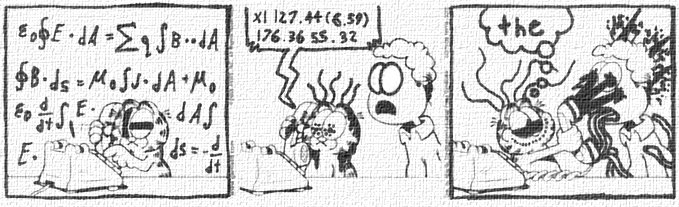
I think I speak for us all when I say that that is probably the best Garfield cartoon I've ever seen.
Anyway, the real reason I brought all this up is to show you this image, which demonstrates pretty effectively the idea of black math:
I think I speak for us all when I say that that is probably the best Garfield cartoon I've ever seen.
Friday, August 4
Lightning Strikes in Toronto
This incredible photograph makes me miss Toronto. Using my powers of triangulation, I was able to determine from the satellite images at Google Maps that the photographer was at the high-rise on the northeast corner of Bay and Edward.
Thursday, June 29
This is why Friendster and Orkut and all those other FoaF services don't work.
Because we have Real Social Networks already; we're homo sapiens sapiens and that particular ape is very good at tracking social relationships all by itself.
Monday, June 26
On the naming of Sports Teams
I know someone who simply cannot grasp the modern naming style of certain sports teams. Oilers, Hurricanes, Penguins, even Maple Leafs she can understand - on these teams such as these, each player is a single "senator," a "knickerbocker," or perhaps a "Red Sock." The team is therefore collectively called the Giants or the Jets or the Argonauts or what have you.
But these basketball team names really confuse her. The Miami Heat? Heat is singular! How can many players form a team called a "heat?" What is a "heat" anyway? Same thing with the Utah Jazz or the Orlando Magic. These teams should be called the Miami Heat Sources or the Orlando Magicians or the Utah... uh, Jazz Musicians.
These modern-sounding American-style names really confuse foreign ears too. When Major League Soccer was founded in the United States back in 1993, many of the teams had wacky names such as the Kansas City Wiz (later the Wizards) or the San Jose Clash (later the Earthquakes). According to the Wiki article, these name changes occured to lure more traditional-minded Hispanic soccer fans to the league. Witness the Dallas Burn (hunh?), which became FC Dallas in 2005. FC stands for Futból Club, a naming convention popular among many Latin and European teams.
Letting the popular masses name a sports team may not always be a good idea. The Toronto Raptors started their first season in 1995, but well before that, the organization held a contest within the city to name the new NBA expansion team. Jurassic Park was the movie-du-jour at the time, so instead of receving a name that reflected Toronto's rich botanical or avian diversity (as its hockey and baseball teams respectively do), the basketball team was named after a species of dinosaur popularized in a Michael Crichton adaptation.
I guess it's all for the best. You can guess what the Toronto Raptors would be called if they had been founded this year: The "Toronto Snakes on a Plane." I can just picture the logo.
But these basketball team names really confuse her. The Miami Heat? Heat is singular! How can many players form a team called a "heat?" What is a "heat" anyway? Same thing with the Utah Jazz or the Orlando Magic. These teams should be called the Miami Heat Sources or the Orlando Magicians or the Utah... uh, Jazz Musicians.
These modern-sounding American-style names really confuse foreign ears too. When Major League Soccer was founded in the United States back in 1993, many of the teams had wacky names such as the Kansas City Wiz (later the Wizards) or the San Jose Clash (later the Earthquakes). According to the Wiki article, these name changes occured to lure more traditional-minded Hispanic soccer fans to the league. Witness the Dallas Burn (hunh?), which became FC Dallas in 2005. FC stands for Futból Club, a naming convention popular among many Latin and European teams.
Letting the popular masses name a sports team may not always be a good idea. The Toronto Raptors started their first season in 1995, but well before that, the organization held a contest within the city to name the new NBA expansion team. Jurassic Park was the movie-du-jour at the time, so instead of receving a name that reflected Toronto's rich botanical or avian diversity (as its hockey and baseball teams respectively do), the basketball team was named after a species of dinosaur popularized in a Michael Crichton adaptation.
I guess it's all for the best. You can guess what the Toronto Raptors would be called if they had been founded this year: The "Toronto Snakes on a Plane." I can just picture the logo.
Sunday, June 25
Dayvan Cowboy
Is it fitting that one of the best instrumental minimalist electronic tracks of all time should have the best video?
Yes.
Yes.
Wednesday, June 21
Friday, June 16
Don't sound stupid.
Stop using comma splices.
Geez, Academy of Linguistic Awareness! Either of these would have worked:
Now your cover is blown, and your chances of affecting a perfectly good cause are shot.
(via boingboing)
P.S.
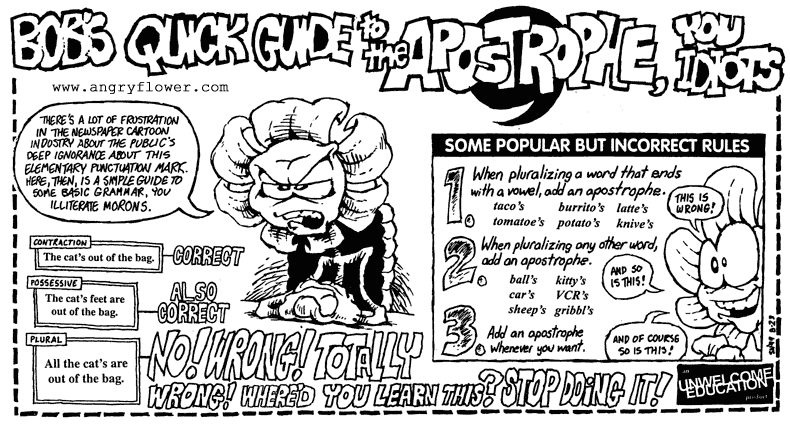
This is sadly similar to Stephen Notley's attempt to correct society's greivous apostrophe errors. (He of Bob the Angry Flower fame.) He publishes this insanely brilliant, popular, and world-altering strip:
Bob's Quick Guide to the Apostrophe, you Idiots
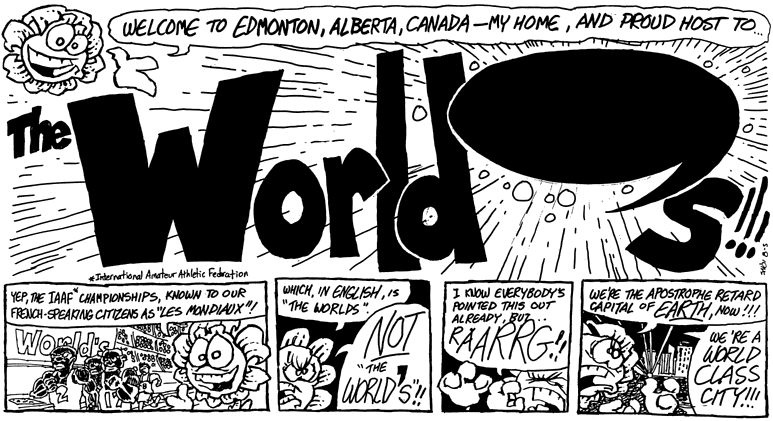
But then he blows his cover with this one.
Worlds
He mistakenly thinks that the name of the competition, the "World's" is incorrectly pluralized, when in fact it is simply the World's Gymnastics Competetion or something like that. There are no multiple "worlds" participating.
To be fair, he fessed up to his error in the annotations of the printed book, and he more than made up for it with a series of other linguistic propaganda leaflets such as this one:
Bob's Quick Guide to French, you Idiots
P.P.S. The "Acadamy [sic] of Linguistic Awareness" is a satirical group. Notice the spelling errors in their poster, not to mention their name. Is the comma splice intentional? I don't know, but one thing is certain: people should stop saying "like" so often.
Geez, Academy of Linguistic Awareness! Either of these would have worked:
Don't sound stupid; stop saying like.
Don't sound stupid. Stop saying like.
Now your cover is blown, and your chances of affecting a perfectly good cause are shot.
(via boingboing)
P.S.
This is sadly similar to Stephen Notley's attempt to correct society's greivous apostrophe errors. (He of Bob the Angry Flower fame.) He publishes this insanely brilliant, popular, and world-altering strip:
Bob's Quick Guide to the Apostrophe, you Idiots
But then he blows his cover with this one.
Worlds
He mistakenly thinks that the name of the competition, the "World's" is incorrectly pluralized, when in fact it is simply the World's Gymnastics Competetion or something like that. There are no multiple "worlds" participating.
To be fair, he fessed up to his error in the annotations of the printed book, and he more than made up for it with a series of other linguistic propaganda leaflets such as this one:
Bob's Quick Guide to French, you Idiots
P.P.S. The "Acadamy [sic] of Linguistic Awareness" is a satirical group. Notice the spelling errors in their poster, not to mention their name. Is the comma splice intentional? I don't know, but one thing is certain: people should stop saying "like" so often.
Tuesday, June 6
They Lied To Us
This was supposed to be the future apocalypse.
Where is myjetpack river of blood,
Where are myrobotic companions locusts,
Where are mydinner in pill form boils,
Where is mynuclear-powered levitating house Earth rent asunder?
(thanks, The Bishop Of Turkey.)
Where is my
Where are my
Where are my
Where is my
(thanks, The Bishop Of Turkey.)
Monday, June 5
The Cost
Schneier points out a Solzhenitsyn quote from Cancer Ward, and it got me thinking. (Thanks, James.)
As one of the comments says, there's a cost to everything nowadays. We're richer now, as a society, than anyone has ever been at any time. We have more than enough food, we have warmth and safety in the dead of winter, we have a say in our government, we have rich, soft clothes, we have entertainment, we have long lives, we know an incredible amount about how our world works, and those of us sufficiently 'net-savvy as to be reading this blog have access to the almost all of that knowledge. But there's a cost! We paid for our food with environmental degradation. We paid for our warmth with the creation of dams, and the exploitation of fossil fuels. We paid for our freedom of goverment with the requirement for eternal vigilance thereof. We paid for our soft clothes with the time and energy it takes to keep up with fashion. We paid for our entertainment with advertisments selling us things we don't need. We paid for our knowledge with immense amount of wasted effort pursuing ultimately worthless ideas, and lastly but certainly not leastly we paid for the internet with our privacy.
There ain't no such thing as a free lunch. Everything has a cost. Most times, we don't even know we're paying it, but we are.
As one of the comments says, there's a cost to everything nowadays. We're richer now, as a society, than anyone has ever been at any time. We have more than enough food, we have warmth and safety in the dead of winter, we have a say in our government, we have rich, soft clothes, we have entertainment, we have long lives, we know an incredible amount about how our world works, and those of us sufficiently 'net-savvy as to be reading this blog have access to the almost all of that knowledge. But there's a cost! We paid for our food with environmental degradation. We paid for our warmth with the creation of dams, and the exploitation of fossil fuels. We paid for our freedom of goverment with the requirement for eternal vigilance thereof. We paid for our soft clothes with the time and energy it takes to keep up with fashion. We paid for our entertainment with advertisments selling us things we don't need. We paid for our knowledge with immense amount of wasted effort pursuing ultimately worthless ideas, and lastly but certainly not leastly we paid for the internet with our privacy.
There ain't no such thing as a free lunch. Everything has a cost. Most times, we don't even know we're paying it, but we are.
Friday, June 2
Peter Gabriel
...writes good music. Or at least, he did on Us and So, the two albums of his I recently got in a fit of "hey, I remember liking that stuff in high school". It's like getting two more Dave Matthews albums for free! (OK not really, but they're similar enough that someone who doesn't listen to either at all might confuse them.)
I'd never really listened to his stuff all the way through before. I mean, sure, it's been on while I was over at people's houses, so it all seemed vaguely familiar (or is that just that all his songs sound the same?) but now, I'm actually listening to it. Amazing how long it takes to (re)discover some things.
I'd never really listened to his stuff all the way through before. I mean, sure, it's been on while I was over at people's houses, so it all seemed vaguely familiar (or is that just that all his songs sound the same?) but now, I'm actually listening to it. Amazing how long it takes to (re)discover some things.
Subscribe to:
Posts (Atom)